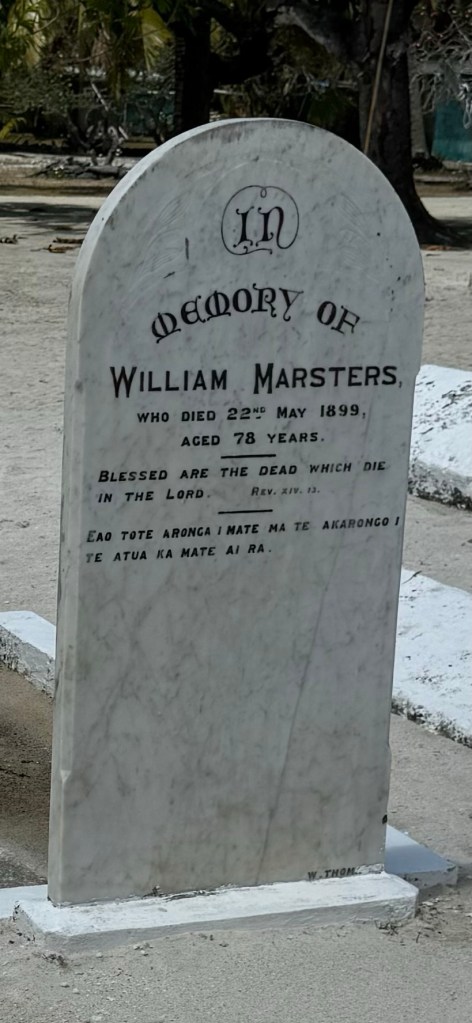
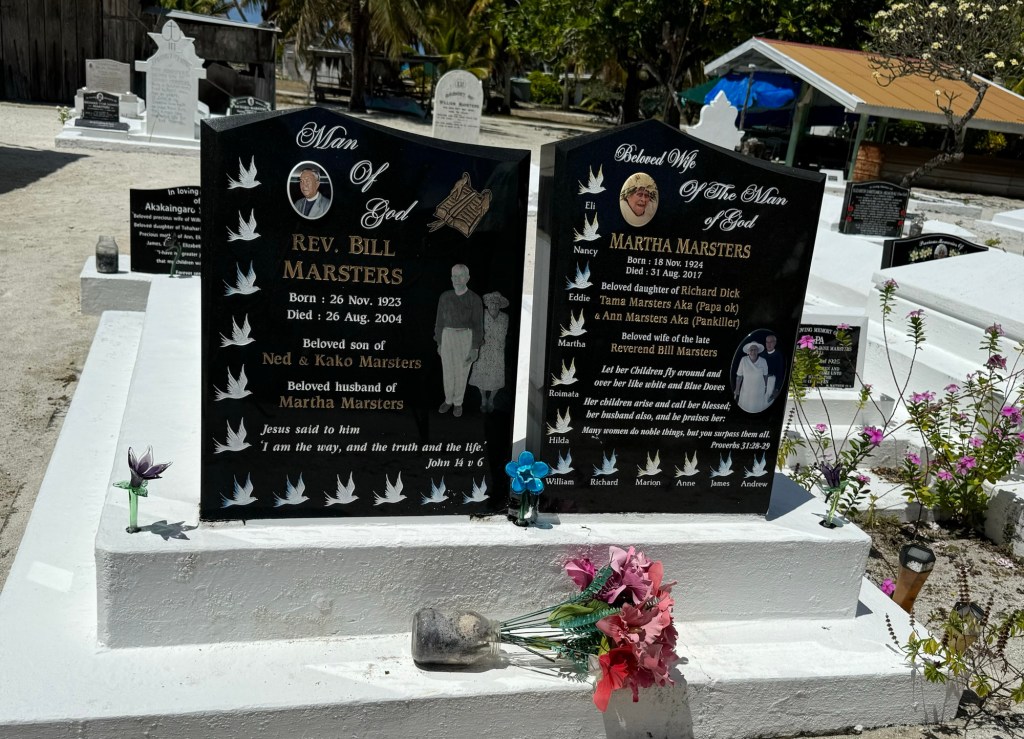
Palmerston is such a special place where we stepped into living history and rich generosity. In 1777, Captain Cook named uninhabited Palmerston after a naval officer. It got interesting in 1863 when William Marsters, a British ship carpenter and barrel maker, settled in Palmerston with his two Polynesian wives. He later added a third wife and sired 23 children. Britain granted Marsters a 21 year lease to Palmerston, which was extended to 1954. In 1954, then under New Zealand control, Marsters descendants were granted full ownership of the island. When Marsters’ last child died in 1973, reportedly over one thousand descendants were living in the Cook Islands and New Zealand. Currently Palmerston has 28 residents.
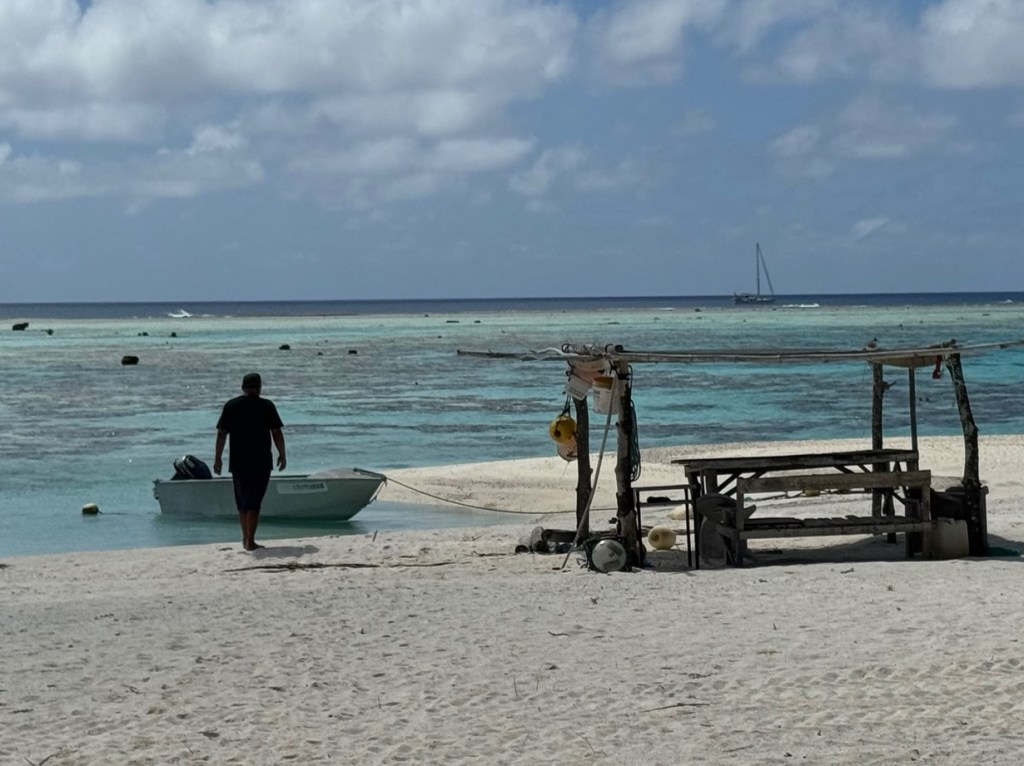
Tieton on Other Side of Reef
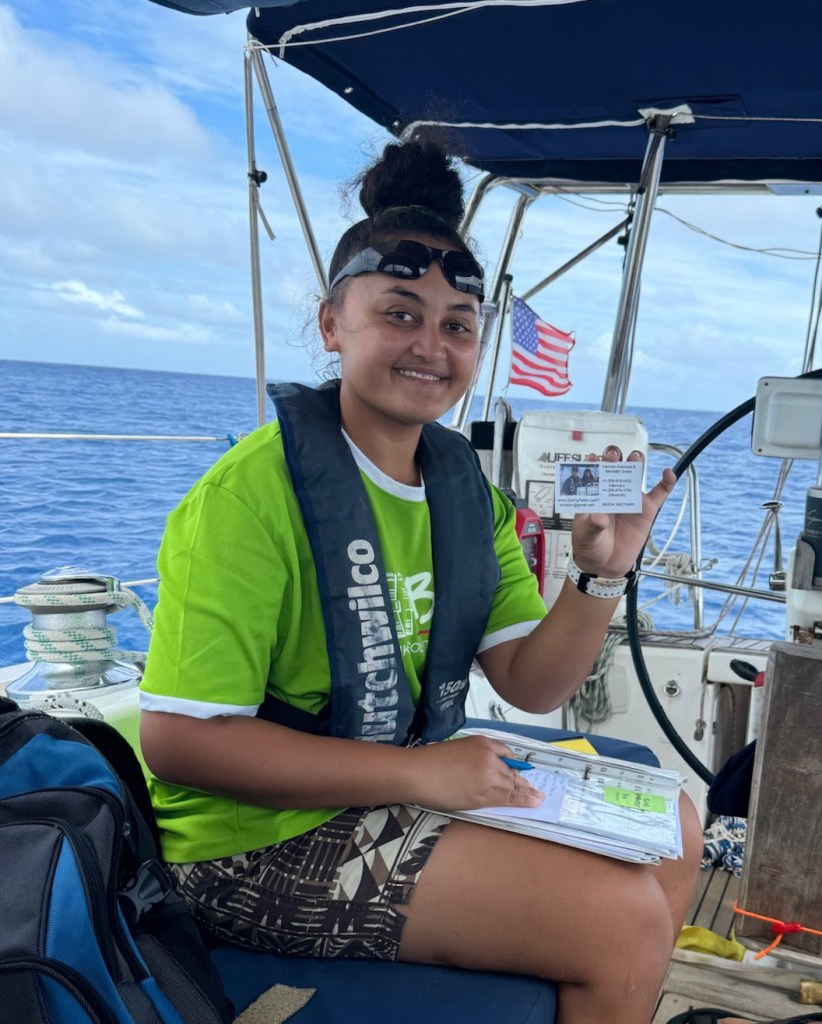
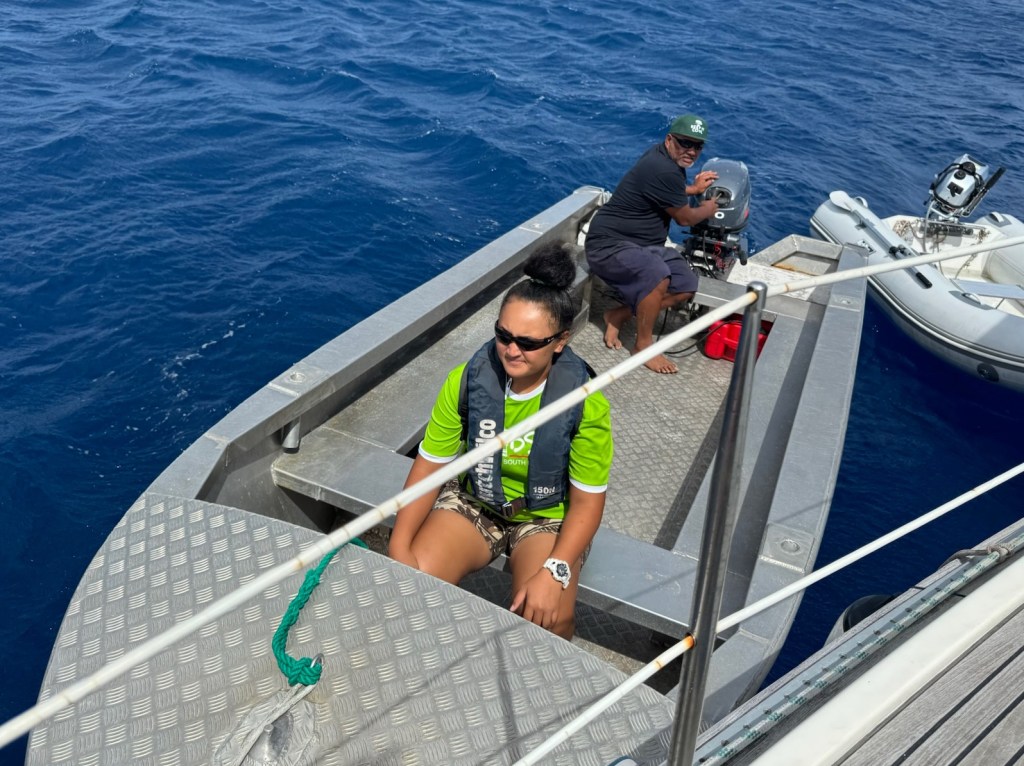
The island is surrounded by a reef with two narrow passages, and sailboats are no longer allowed inside the reef. The Kitsap Banks are at the NE part of the island, which might be of interest to those in Kitsap County, Washington. We anchored and via radio notified Palmerston of our arrival, and a half hour later Bob brought Juliana to review our paperwork and collect our $20 entry fee. Bob introduced himself as our host for the entirety of our visit and offered to take us ashore. Juliana appreciated our boat card and told us it would soon be glued into her journal and surrounded by glitter. A solo sailor had previously asked for our help, so we told Bob we’d contact him after we’d finished that. Bob told us he wanted to have us back to the boat by 3 PM, so that he could participate in the final day of their constitution celebration.

Later I radioed Bob that the work had taken so long that we wouldn’t go ashore that day. Bob responded that he’d pick us up at 9 AM the next day (Sunday), we’d go to church at 10 AM, and then have lunch afterwards. We mentioned going for a snorkel and were told no swimming is allowed on Sundays.
We spent the afternoon resting while we watched a mother whale and her calf surface in the distance.
Our Hosts Bob & Topoh
Bob and his wife Topoh provided an extraordinary glimpse into life on Palmerston. Bob and their daughter picked us up at our boat, and we were offered coffee or tea before church. The daughter begged off because she, along with a few islanders, had caught a flu from a visitor the previous week. We went to church, had lunch and walked around the island.
Bob was born on Palmerston and Topoh on a nearby island. They met in Roratonga, the largest of the Cook Islands, where Bob was a police officer, and returned to Palmerston to raise their family of six children. Their youngest daughter is 13, and their older children now live in New Zealand and Australia. Bob and Topoh are in their mid 50’s, they’re now the elders on Palmerston.
Their original open air house has been supplemented with a sleeping house for the four daughters, bathrooms & laundry structure, and an outdoor sleeping area for the adults.


Bob & Topoh fish the reef using a net, package the parrot fish, and freeze it to await transport by the freighter that comes four times a year, which is also how they receive their staples. When the freighter arrives, they transfer the frozen fish to broken freezers labeled with their name and island, seal the freezers, and transport them to the freighter waiting outside the reef. In Roratonga 24 hours later when the freighter arrives, restaurants pick up the fish they’ve agreed to purchase, which has been labeled for them. That’s farm to market!
Bob is the mayor and explained how busy they’d been. In late July, a matriarch’s remains were retuned to the island, and the many visitors who attended the internment were hosted by residents. Then the climate change team visited for two weeks from New Zealand to talk with the islanders about rising sea levels, not burning plastic, and other environmental issues. Bob mentioned that he used to be able bring his boat further up the beach, but over the years a sand bar has accumulated and it is tougher to get the boat through the more shallow waters. The previous year a team from New Zealand came to eradicate rats.
With the conclusion of all the business, they now had time for the Constitution Celebration, marking the Cook Islands’ independence from New Zealand, that had been deferred since early August. Thursday was sports competitions. Friday a fishing competition was held, after which the fish were processed and split amongst the villagers. Saturday concluded with dancing, singing and a feast.
Bob and Topoh generously provided lunch for us. Herman grilled beef that had come on the supply ship, plus tuna caught the previous day. Side dishes were potato salad, fried rice, coleslaw, and tomato-cucumber salad. Because it was Sunday, we also had raspberry soda. They’ve been told by the island nurse to reduce their sugar consumption, drink water and exercise. Other than the tuna, everything came via supply ship or visiting cruisers. Topoh allowed me to help with the dishes, which were washed in the sink filled with fresh water from a bucket.
Church
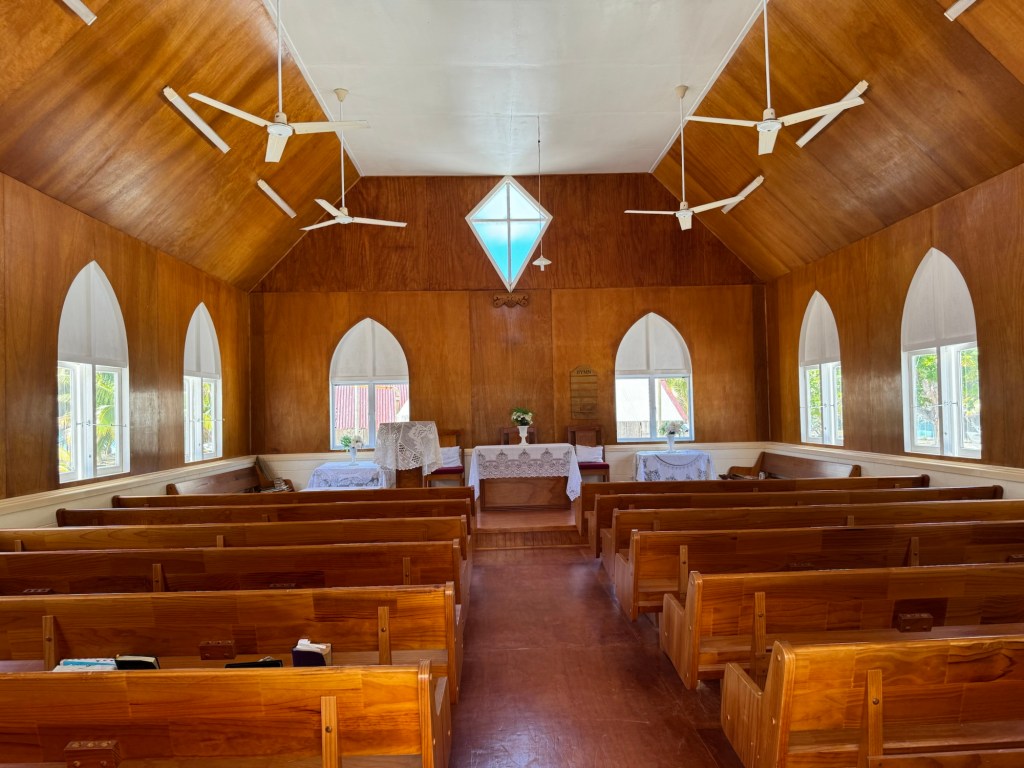
The simple church was rebuilt in the late 1990’s when the original church was about to fall down. It seemed that all islanders attended the service except those that were ill. Men sat on the left, women on the right, and children with their chosen parent. The pastor was not a descendant, and had been brought in and housed by the mission. The service was in English, and hymns were mostly in the traditional language and one was in English. Later I told Topoh I appreciated her singing, she said that as the elder woman, it was important for her to teach those who are younger.
The pastor reminded the parishioners how important it was to rest on Sunday, especially after all the activities and the flu that was going around. He encouraged naps, and as we walked quietly around the island later, we noticed that many complied and were napping in hammocks or outdoor beds.
Coconuts
Herman asked about coconuts and Bob launched his explanation about the many uses of the coconut, or the tree of life. Using a machete, a hole is cut in the top of green coconuts, and the hole is used for sipping the coconut water out of the shell. After finishing the water, the coconut is split to eat the flesh or give to the chickens or pig. Ripe coconuts are shredded and squeezed, which produces coconut milk/cream/oil, then the pulp is fed to chicken and pigs. The spongy flesh of sprouted coconuts is delicious on its own or combined with raw fish and coconut milk. The leaves and trunks are used for houses. The white tips of fronds and the hearts of the palm tree are also eaten.

Rat Eradication
Many islands have rat problems which are an introduced species with no natural predators. Palmerston was overrun with rats, which caused public health concerns. Additionally rats eat eggs and baby birds, which is devastating to bird populations. Last year the New Zealand health authorities worked with islanders to eradicate the rat population. All chickens, cats, and pigs were removed, euthanized, or butchered, so that they wouldn’t be poisoned. Rats were poisoned or trapped, until they were completely eliminated. After several months of no rat sightings, the health authorities brought in 12 pigs and some chickens, which were distributed around the island, which established a basic breeding stock. It has now been over a year since anyone has spotted a rat. It had been awhile since we’d seen a chicken with more than one or two chicks and they’re thriving now.
Island Tour
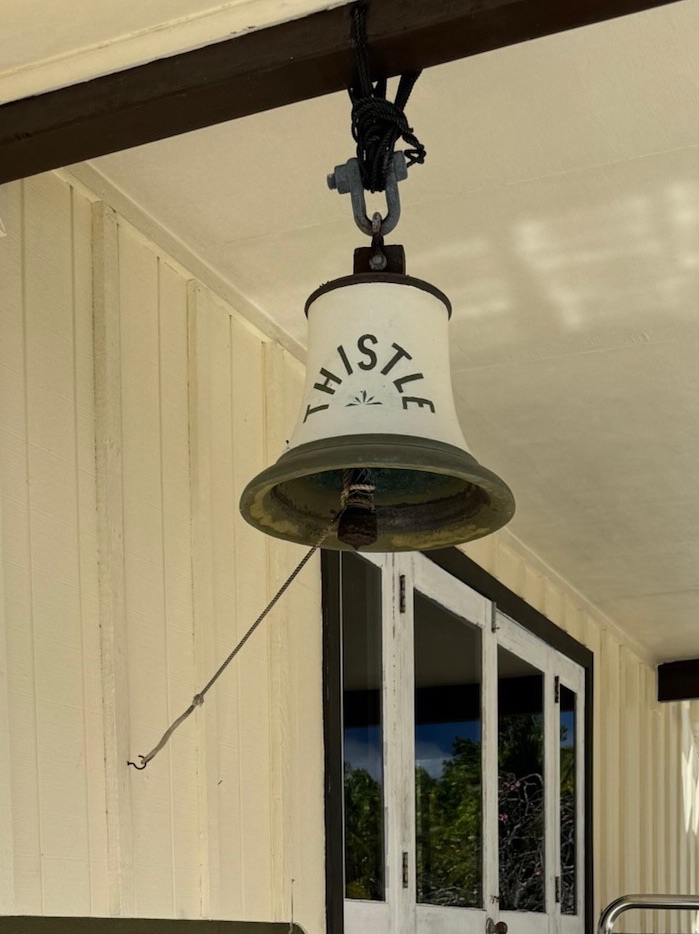
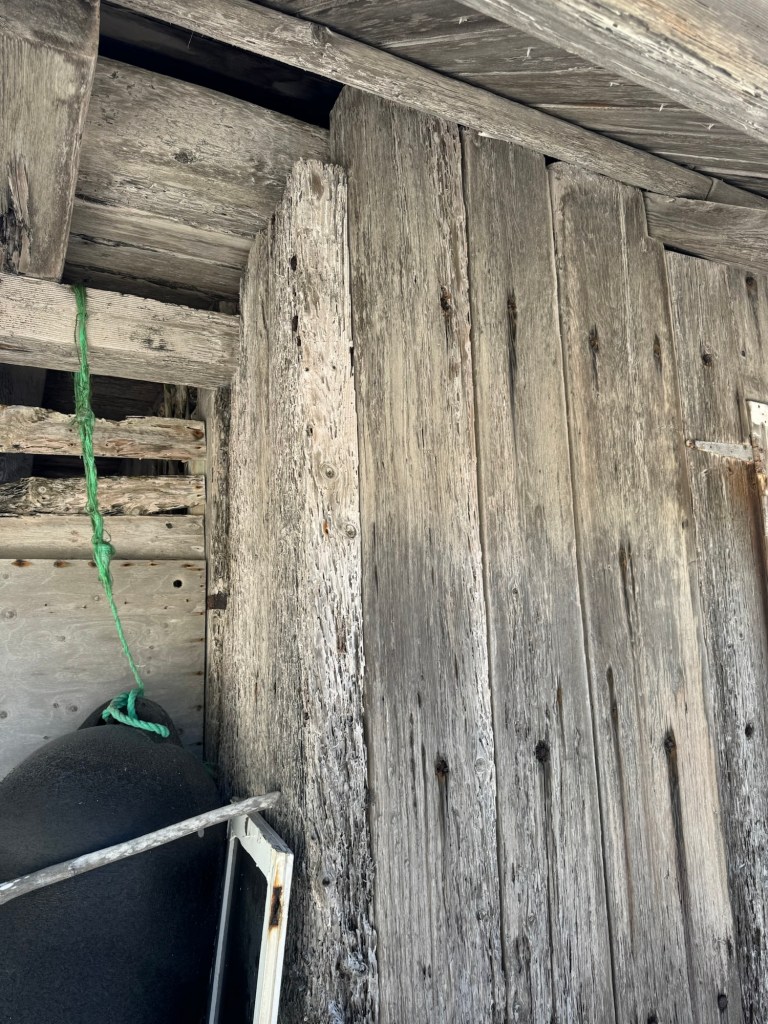
Bob encouraged us to explore the island on our own, since he also had a cold. We visited the cemetery adjacent to the church, which is dominated by Marsters’s headstones. Thistle was shipwrecked on Palmerston, and its bell now serves as the church bell. Its timbers, originally destined for Australian mines, were used to build one of Marsters’ homes and stands today, having survived multiple cyclones. It didn’t surprise us, given /that the beams and joists were basically 12 inches x 12 inches.
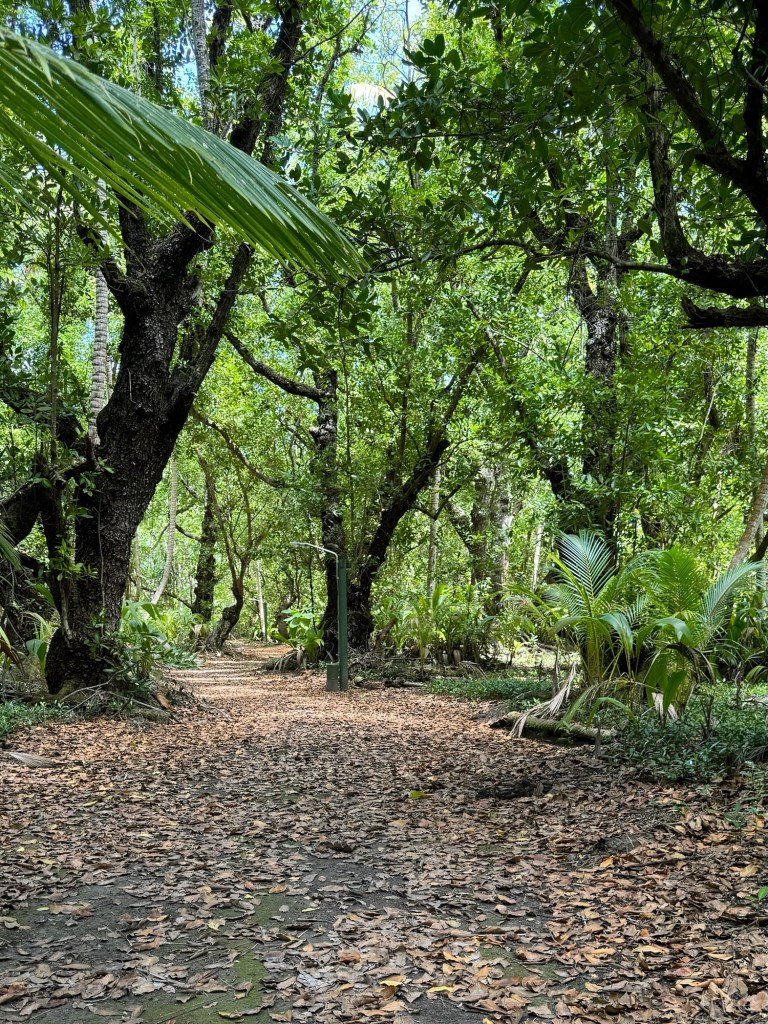
Some of the dirt paths/streets are lighted with solar powered street lamps, which seem a little out of place. We walked on the beach, confident that we could find our way back because ours were the only footprints.


What’s Next
We are so glad that we took the short detour to Palmerston, which broke up our passage from Aitutaki to Niue. Niue, an island country, is 400 miles or three days away. Although our stop here was brief, we will long remember our hosts, their simple life and incredible generosity.


 Sailing Tieton
Leave a comment